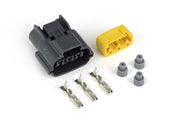
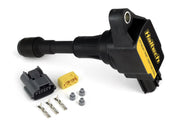
About the LS2 coil
This is the high-output inductive coil GM fitted to most Gen 4 LS2 and LS3 engines. It has its igniter built in, so the ECU only sends a low-current trigger signal and the coil does the switching itself. If you're unsure what that means for your setup, our internal igniter or not article explains the difference. Haltech doesn't sell this particular coil, but it's easy to source and very common in swaps.
There's also a truck variant you'll recognize by its large heat sink. It wires up exactly the same way as the standard coil.
The LS2 coil needs spark plug leads with the correct ferrule-style boot. With the wrong lead end, spark can jump from the output post to the metal mounting section of the coil instead of going down the lead.
Wiring
The pin letters are molded into the connector shell.
| Pin | Function | Connect to |
|---|---|---|
| A | Ground (spark return) | Cylinder head |
| B | Ground (signal reference) | ECU signal ground, or the cylinder head (see below) |
| C | Trigger | ECU ignition output |
| D | Power | Switched +12 V |
The two-ground question
On paper, pin A is the high-current return for the spark and belongs on the cylinder head, while pin B is the reference the coil uses to read the ECU's trigger signal, so it belongs on ECU signal ground. That's the official layout.
In practice, Haltech's advice is to take both A and B to the cylinder head, and that's what we do too. Here's why. If the engine's ground strap is poor, spark current looks for another way home, and it can find one through the coil's signal ground and the ECU wiring. That can damage coils. A weak engine ground can also lift the signal reference enough that the coil stops seeing the trigger and misfires. Grounding both pins at the head removes that path. The real fix for either problem is still a solid engine ground, and our ECU grounding dos and don'ts covers how to do that properly.
Power supply
Each coil can pull up to about 10 A. On a high-rpm, high-power engine running conventional 30 A relays, it can occasionally be necessary to give each pair of coils its own fuse and relay. It's uncommon, but undersized wiring or a single overloaded relay will limit spark energy just when you need it most. See how relays work if you're planning the power side.
ECU settings
| Haltech Elite setting | Value |
|---|---|
| Ignition Mode | Depends on your installation |
| Ignition Edge | Falling |
| Ignition Dwell Mode | Constant Charge |
Dwell: less is more at high rpm
The biggest LS2 coil gotcha is dwell. Charge one for much longer than about 5 ms and it can discharge on its own, firing the plug at a random point instead of when the ECU asked. The problem seems to come from the "break" time, the gap between one firing event and the next charge. At low rpm there's plenty of break time, so an over-long dwell can seem fine at idle and on the street. As rpm climbs the break time shrinks and the random firing shows up.
So don't overcharge these coils, especially up top. Use a dwell table that falls away as rpm rises rather than a single flat value. Haltech publishes a suggested dwell curve for this coil. Need it? Ask us and we'll send it over with advice for your build.
Troubleshooting
| Symptom | Usually |
|---|---|
| Runs fine low, erratic timing or misfire at high rpm | Too much dwell for the available break time |
| Intermittent no-fire, worse under load | Poor engine ground lifting the signal reference |
| Burned coils or damaged ECU wiring | Missing or weak engine ground strap forcing current through the coil grounds |
| Spark tracking to the coil body | Plug leads without the correct ferrule boot |
| Weak spark near redline on a big engine | Supply voltage sagging from undersized wiring or an overloaded relay |
FAQ
Is the LS2 coil the same as the LS1 coil?
No. They're different coils, so check the wiring and dwell for the one you actually have. See our LS1 ignition coil page for that one.
Can I use LS2 coils on a non-GM engine?
Yes, that's very common. The wiring and dwell advice above applies no matter what engine they're on. For LS engine specifics, see the LS2/LS3 Gen 4 engine page.