What the IGN-1A is
The IGN-1A (HT-020114) is an inductive ignition coil with the igniter built in, so it can be triggered straight from an ECU ignition output. It delivers very high spark energy while keeping the long burn time of a conventional inductive coil, which is why it shows up on everything from rotaries to V8s and inline sixes. If you're unsure whether your current coils need an external igniter, our internal igniter or not article explains how to tell.
Why a long spark matters
At idle and light throttle there's very little air and very little fuel in the cylinder. The spark has to find a burnable pocket of mixture, and that's harder when the fuel isn't well atomized, which is common with large, high-flow injectors. A capacitive discharge (CDI) system fires an intense spark, but it's over very quickly. If it misses the mixture, you get a misfire.
Tuners often work around light-load misfires on a CDI by richening the mixture or retarding timing, but both cost economy and drivability. An inductive coil like the IGN-1A keeps the spark burning much longer, giving it more time to light the charge. That's the main reason almost every factory ignition system is inductive, and why the IGN-1A resists light-load misfire so well.
ECU settings
| Setting (Elite) | Value | Notes |
|---|---|---|
| Ignition Mode | Depends on the install | Match your trigger and coil layout, for example direct fire with one coil per cylinder |
| Ignition Edge | Falling | Confirm with a timing light before running under load |
| Ignition Dwell Mode | Constant Charge | Dwell then comes from the dwell table |
Dwell: the part people get wrong
The IGN-1A is thermally limited. It keeps gaining energy until fairly long dwell times, but holding it near full charge all the time makes it hot, and heat kills coils. The answer is to run modest dwell where the engine doesn't need a big spark and only give it full energy when cylinder pressure is high.
To do that, map the dwell table against battery voltage and engine load. A typical shape, from Haltech's example:
- At a normal running voltage of about 14V and off boost, around 4.5 ms of dwell.
- As boost rises, dwell ramps up gradually, reaching full spark energy at about 200 kPa (roughly 30 psi absolute).
- At low voltage, such as during cranking, dwell is increased so the coil still makes a strong spark to help starting.
That gives a strong spark where you need it and keeps the coils cool the rest of the time. Treat these as a template, not a finished table. Confirm there's no misfire under load in your logs, and check coil temperature after a hard session. Our dwell time article covers how dwell tables work in more detail.
Power supply
Each IGN-1A can draw up to 15A. On a high-revving, high-boost engine, several coils sharing one 30A relay can run out of current, and the result is a weaker spark exactly when you need it most. Haltech has seen this on rotary engines turning over 10,000 rpm on high boost. In that kind of build, give every pair of coils its own fuse and relay.
Wire size matters just as much. Undersized power wiring drops voltage under load and limits spark output even with good relays.
Grounding
The coil has three ground connections, which confuses a lot of people. If in doubt, join all three and run them to the cylinder head. That protects you in two ways:
- If the engine ground strap is poor, current can look for another path back to the battery, and the coil's grounds can end up carrying it. A solid ground at the head stops that.
- If the engine's ground floats relative to the ECU, the trigger signal from the ECU can effectively disappear and the coil won't fire.
Joining the grounds is a workaround. The real fix for either problem is a proper engine-to-chassis and engine-to-battery ground.
Wiring and harness options
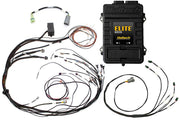
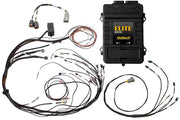
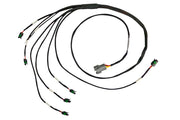
For a clean install, use the IGN-1A plug and pin set, or a ready-made harness such as the universal inline six IGN-1A harness. For 13B rotaries, Haltech offers Elite 1500 terminated harness kits with IGN-1A ignition for the S4/5 CAS and S6-8 CAS engines. Rotary owners should also read our piece on rotor phasing. Need the wiring diagram? Ask us and we'll send it over with advice for your build.
Troubleshooting
| Symptom | Usually |
|---|---|
| Misfire at high RPM and boost | Not enough dwell at high load, too many coils per relay, or undersized power wiring |
| Coils running very hot | Dwell too high at light load |
| Coil won't fire, or fires erratically | Engine grounding problem, wrong ignition edge, or wrong output assigned |
| Hard starting | Not enough dwell at cranking voltage |
FAQ
Can I fire the IGN-1A directly from my ECU?
Yes. The igniter is built in, so no separate igniter module is needed.
Why not just run maximum dwell everywhere?
Because the coil is thermally limited. Full dwell at idle and cruise heats the coil for no benefit and shortens its life.
How is the IGN-1A different from a CDI like an MSD?
A CDI makes a short, intense spark. The IGN-1A makes a long inductive spark with high energy. See our MSD 6AL article if you're comparing the two.