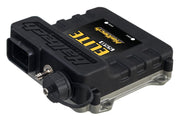
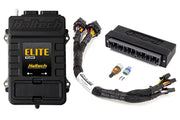
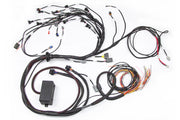
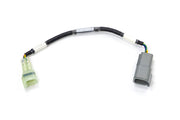
Who the Elite 750 is for
The Elite 750 fills the spot between the very basic Elite 550 and the larger Elites. It gives you six injector and six ignition channels in a small waterproof case, runs Haltech's ESP software, and comes fully unlocked, so features like flex fuel and closed loop O2 control don't cost extra. We see it most on four-cylinder and six-cylinder street and weekend cars with cable throttle, where the owner wants a proper standalone without paying for I/O they'll never use.
Inputs and outputs
| Channel | Qty | Notes |
|---|---|---|
| Fuel injection outputs | 6 | Peak and hold, 0-8A peak / 0-2A hold |
| Ignition outputs | 6 | For coils with built-in ignitors, or an external ignitor |
| Engine position inputs | 2 | Trigger and home, with wide trigger pattern support |
| Digital pulsed inputs | 2 | Digital signals only |
| Digital pulsed outputs | 5 | Relays, solenoids, idle and boost valves |
| Analog voltage inputs | 2 | General purpose 0-5V sensors or switches |
| Dedicated inputs | 3 | One each for throttle position, coolant temp and air temp |
| Internal MAP sensor | 1 | 3 bar, good for about 29 psi (200 kPa, 2 bar) of boost |
| CAN bus | 1 | For Haltech CAN expansion devices |
The number that usually decides things is the two spare analog inputs. Once TPS, coolant and air temp are on their own dedicated inputs, you have two AVIs left for items like oil pressure, fuel pressure or a switch. If you need more sensors than that, CAN expansion helps, but it's also the point where we start looking at a larger Elite.
Features that come standard
- Sealed case: rated IP67, but only with the USB port sealed by the waterproof USB cap or the waterproof USB extension cable, both sold separately.
- Connector: a single 34-position AMP connector.
- Onboard datalogging so you can review a drive without a laptop connected.
- Multi-fuel support for gasoline, methanol and ethanol, with direct connection of a flex fuel sensor for E85.
- Closed loop O2 control and user-definable tables.
- Injection modes: sequential, semi-sequential, batch or multipoint.
- Ignition types: distributor, multi-coil, or Haltech Multiplex CDI.
- Load sensing by MAP, throttle position or MAF.
What the channel count means in practice
Six injector and six ignition outputs are enough for sequential fuel and coil-on-plug spark on any four- or six-cylinder. A V8 can still be run with batch or semi-sequential fuel and wasted spark or a distributor, but if you want full sequential on eight cylinders you need a bigger ECU. You'll also notice the I/O list has no stepper motor or drive-by-wire motor drivers, so cars with electronic throttle or a stepper idle valve need a different Elite.
Specifications
| Spec | Value |
|---|---|
| Supply voltage | 8-16 V DC |
| 5V sensor supply | 100 mA max |
| Dimensions | 5.0 x 5.0 x 1.54 in (127 x 127 x 39 mm) |
| Weight | 0.77 lb (350 g) |
That 100 mA limit on the 5V supply matters if you're adding sensors. Several powered sensors on the same 5V rail can add up, so check each sensor's draw if you're filling every input.
Harness options
For custom installs, the basic and premium universal wire-in harnesses save a lot of work, and there's a loose plug and pin set if you're building your own. Before you wire anything, keep the Elite 750 complete pinout and the basic harness wiring diagram handy.
Elite 750 FAQ
Can the Elite 750 run a turbo car?
Yes. The internal MAP sensor reads up to about 29 psi of boost, and boost control can run from a spare output. Past that boost level, use an external MAP sensor on an analog input.
Elite 550 or Elite 750?
Compare them on our Elite 550 overview. If you're unsure, a free 30-minute consultation with us will sort it out quickly.