What the ECU does with coolant temperature
The Elite uses coolant temperature to decide how much extra fuel a cold engine needs, when warm-up enrichment can fade out, and when to warn you or protect the engine if things get hot. It's also one of the most useful channels in a log. So even though it's a simple two-wire sensor, it's worth a few minutes to configure well.
A typical coolant sensor is a thermistor. One wire goes to an analog voltage input (AVI) on the ECU and the other goes to signal ground. As temperature changes, the resistance changes, and the ECU turns that into degrees using a calibration.
Wiring tab
Input Type
| Option | Pick it when |
|---|---|
| Analogue Voltage | The sensor maker gives you a table of temperature against voltage. Uses an AVI. |
| Analogue Resistance | The data sheet gives temperature against resistance, which is the norm for thermistors. Also uses an AVI. |
| Thermocouple Type K | You're reading a thermocouple, usually through a Haltech TCA2 or TCA4 amplifier. |
Connections and pull-up
Choose the AVI the sensor is wired to under Coolant Temperature Input. Then decide on the Pull Up:
- Enabled for a normal two-wire sensor that only the Elite reads. The pull-up resistor is what creates a voltage the ECU can measure.
- Disabled when the sensor is shared with another ECU, such as a piggyback setup alongside a factory computer. The other ECU normally supplies its own pull-up, and adding a second one skews the reading for both.
Calibration tab
This is where the temperature curve lives. ESP ships with a set of ready-made calibrations, and the default is for the Haltech 127°C (about 260°F) temperature sensor, so if you're using one of Haltech's own coolant temp sensors you're probably already done. For anything else, load a matching file with the yellow folder (Open) icon, or build a custom calibration from the manufacturer's data and keep it with the blue disk (Save) icon so you can reuse it.
Always sanity-check the result: with a cold engine that has sat overnight, coolant temperature should read close to air temperature. If it doesn't, the calibration or pull-up is wrong.
Display tab
Two simple thresholds make ESP flash coolant temperature gauges red:
- Warning Minimum: below this, the reading is flagged as too cold.
- Warning Maximum: above this, it's flagged as too hot.
These are visual only. They're handy when you're watching the laptop on the dyno, but they don't protect anything by themselves.
Diagnostics tab
This is where the sensor can actually trigger fault codes, and, with Engine Protection running, a response.
| Setting | Code | What it catches | Our advice |
|---|---|---|---|
| Raw Min | P0117 | Voltage below a set value, pointing to a shorted or disconnected circuit | Enable it, with the threshold just outside the lowest voltage the sensor produces when hot |
| Raw Max | P0118 | Voltage above a set value, also a wiring fault | Enable it, just above the highest voltage seen on a cold start |
| Operating Max | P0128 | Coolant temperature conditions that suggest a sudden spike | Worth turning on for any engine you care about |
All three are disabled by default. If the Engine Protection function is active, each can be given a DTC severity level so the ECU reacts rather than just logging a code.
A broken coolant sensor wire doesn't just lose a gauge. The ECU may think the engine is freezing and pile in cold-start fuel, or think it's warm when it isn't. Setting Raw Min and Raw Max means you find out from a code instead of from a fouled plug.
Troubleshooting
| Symptom | Usually |
|---|---|
| Reads extremely cold or extremely hot constantly | Open or shorted wiring, wrong input, or pull-up setting wrong |
| Reads plausible but off by a lot | Wrong calibration for the sensor, or a doubled pull-up on a shared sensor |
| Reading jumps around | Poor signal ground or a corroded connector |
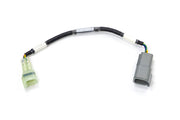
For a deeper dive, see temperature sensor problem diagnosis. If you're building a harness from scratch, the GM-style coolant temp connector makes a tidy termination.