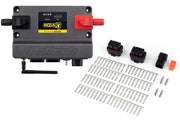
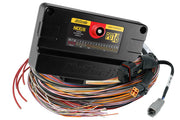
Why monitor battery voltage
Everything the ECU does depends on a stable supply. Injector opening time changes with voltage, ignition coil charge depends on it, and sensors and relays misbehave when it sags. A failing alternator, a loose ground or a tired battery often shows up as a voltage problem long before it strands you. These diagnostics turn that into a clear fault code.
The two checks
| Setting | Code | Catches |
|---|---|---|
| Minimum | P0562 | A sudden drop in battery voltage |
| Maximum | P0563 | A sudden spike in battery voltage |
Both are optional. With Engine Protection active, you can give each one a DTC severity so the ECU reacts rather than just logging the code.
Our advice
Log battery voltage over a normal drive first, including cranking and idle with every accessory on. Set the minimum below the dips you see in normal use, so cranking doesn't trip it, and the maximum above normal charging voltage. A warning-level severity is usually enough; voltage faults are about telling the driver to investigate, not cutting power.
If a code does appear, check the alternator control setup, main power and ground connections, and the battery. The Battery Voltage page covers the channel itself.