What alternator control does
Older alternators have a regulator that decides the charge voltage on its own. Many late-model units, including a lot of LS applications, expect the engine computer to command them instead. The Nexus Alternator Control function sends a duty cycle signal to the alternator's voltage regulator, and the duty sets how hard it charges.
You give the ECU a target voltage, and it adjusts duty in closed loop to hold the battery at that target. A base output table gives it a sensible starting duty, so the controller only has to correct small errors.
The settings
| Setting | What it does | Our advice |
|---|---|---|
| Frequency | How fast the control signal pulses | Must match what the alternator expects. Check your alternator's spec |
| Min Duty | The lowest duty the controller will ever send | Keep it where the alternator still behaves predictably |
| Max Duty | The highest duty the controller will ever send | Limits how hard it can charge |
| Proportional | How strongly duty changes for a given voltage error | Raise it if voltage is slow to recover after a load switches on |
| Integral | How quickly it removes a small steady error | Too much makes voltage swing up and down around target |
| Derivative | Dampens the response to cut overshoot and settle faster | Add small amounts only if it overshoots |
Tuning it
Get the base output table close first so the gains have little to do. Then log battery voltage, target voltage and alternator duty while you switch on big loads (fans, headlights, fuel pumps) and blip the engine. If voltage sags and takes a while to come back, add proportional gain. If it settles slightly off target, add a little integral. If voltage oscillates, back integral down before touching anything else. Our PID control mapping guide explains the three terms in more depth.
Set a sensible target and a max duty that can't overcharge. Watch voltage in the logs for the first few drives.
Wiring and adapters
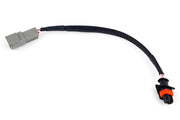
Wiring for the control signal is covered in alternator control wiring. For LS swaps we stock ready-made adapters, including the small Bosch and large Yazaki LS harness adapters and the Nexus Rebel LS 2-pin Bosch alternator harness.