Why an ECU controls the alternator
Older alternators have a built-in regulator that holds one fixed voltage. Many late-model alternators, including those on GM LS engines, instead expect the engine computer to tell the regulator how much to charge. Swap in an aftermarket ECU and forget about that signal, and you can end up with a battery that never charges or a system that runs too high.
The Elite's Alternator Control function replaces the factory computer's role. It sends a pulsed duty signal to the regulator and runs it closed loop: you set a target voltage, the ECU compares it with measured battery voltage, and it adjusts the duty to close the gap.
Not every alternator can be controlled this way. It has to have a regulator that accepts an external duty signal. If you're not sure about yours, ask us before wiring it.
Wiring it up
On the Wiring tab you set two things:
- Alternator Control Output: the ECU wire that will feed the regulator's control terminal. This is usually a DPO (digital pulsed output).
- Active State: which direction the duty works. With
Low, 0% duty is fully off and 100% fully on. WithHighit's reversed. The default is Low. If the charging voltage goes down when you expect it to go up, this is the setting to check.
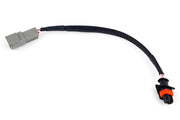
For LS swaps there are ready-made adaptors so you don't need to cut the harness. We stock the small Bosch and large Yazaki LS alternator adaptors, plus the Rebel LS 2-pin Bosch harness for Nexus Rebel builds.
The Alternator Control tab
| Setting | What it does | Default | Our advice |
|---|---|---|---|
| Frequency | How fast the control signal pulses | 300 Hz | Most regulators are happy somewhere around 250-300 Hz. Use the alternator's spec if you have it |
| Min Duty | The lowest duty the controller may use | 0% | Raise it to just below where the regulator starts responding |
| Max Duty | The highest duty the controller may use | 100% | Lower it to just above where more duty makes no difference |
| Proportional | How strongly the controller reacts to the size of the error | 90 | Leave at default unless voltage is slow to recover or hunts |
| Integral | How aggressively ongoing error is corrected over time | 40 | Reduce if the voltage slowly swings above and below target |
| Derivative | Damps overshoot when P is set aggressively | 0 | Usually left at 0 |
Trimming min and max duty to the regulator's real working range keeps the controller from wasting effort in dead zones, the same way you'd set up a boost solenoid. If you're new to PID terms, our PID control mapping article explains what each gain feels like in practice.
The two tables
Alternator Control - Target
The voltage you want the charging system to hold. It can be mapped in up to 2D. Most systems want somewhere between 13.8 and 14.4 V. Aim too low and the battery slowly goes flat. Aim too high and you can damage the battery and stress other electrics.
Mapping it lets you vary the target. For example, you could charge harder right after a start and ease off once the battery has recovered.
Alternator Control - Base
The duty the ECU starts from, also mappable in up to 2D. Closed loop control adds or removes duty from this to reach the target, so the actual output may not match the table. That gap tells you something: if the live duty is always far from the base value, adjust the base table toward what the controller really uses. A good base table means smaller corrections and a steadier voltage.
A setup routine that works
- Wire the output and choose the active state.
- Set the frequency, and leave min/max duty and PID at their defaults for now.
- Enter a sensible flat target, such as 14.0 V, within the normal range.
- With the engine idling and loads like fans and headlights switched on and off, log battery voltage, target and duty.
- Move the base table toward the duty the controller settles on.
- Only then touch the PID gains, and only if the voltage recovers slowly or oscillates.
Troubleshooting
| Symptom | Usually |
|---|---|
| Voltage stuck at battery level, no charging | Wrong output assigned, active state reversed, or the alternator isn't externally controllable |
| Voltage too high and duty at the limit | Active state reversed, so the controller is pushing the wrong way |
| Voltage swings slowly around target | Integral too high, or base table far from reality |
| Voltage dips when fans kick in and recovers slowly | Proportional too low, or max duty set too low |
FAQ
Do I need alternator control on an LS swap?
If the alternator relies on the factory computer for its charge signal, yes, or it won't charge properly. Our adaptors make the connection simple.
Is this the same on a Nexus ECU?
The idea is the same, but the software and menus differ. See alternator control for Nexus.
More Elite functions: thermofan and air conditioner control.