
Session details

Description

About this service

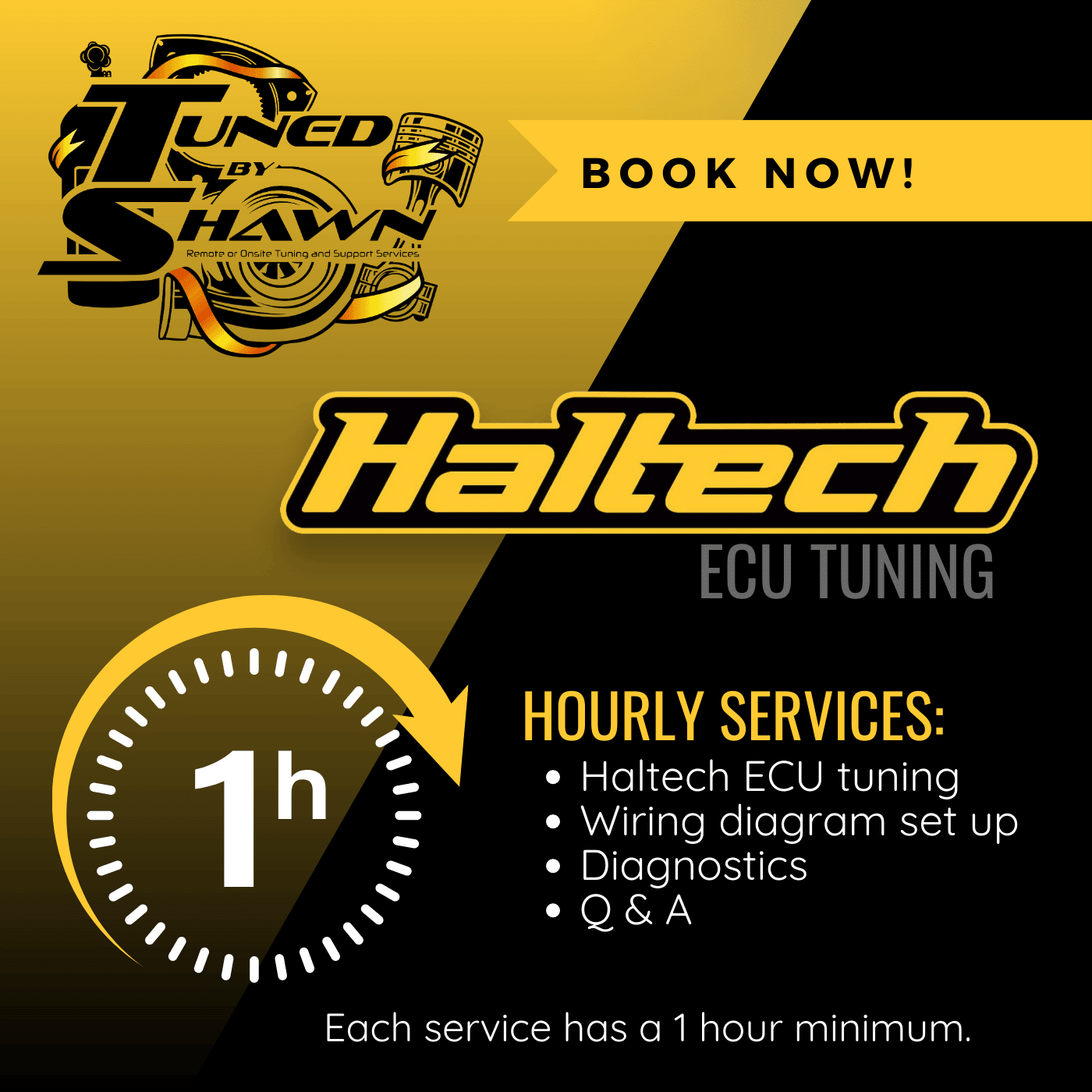
Whether you need your car started for the first time or would like to talk with Shawn LIVE, this service is for you. This hourly tuning service gives you access to expert tuning and more anytime, anywhere.

Tune Adjustments & Support

Improve your vehicle's performance with help from Shawn. We will provide adjustments to your Tuned by Shawn tune, as well as guidance on building and improving your vehicle's setup.

*Please note: We will not make adjustments to other shops tunes*

Expert Wiring Consulting

Unsure of what changes will give you the right result? Let us help! We can provide guidance and help with your wiring diagram setup in real time.

Diagnostics & Maintenance

We can quickly diagnose any issue and make sure everything is in optimal running condition. Keep your ride running smooth and worry free!

    Please when you are done checking out book with our schedule system.

    FAQs

    How Remote Tuning Works

    How my live, Zoom-based Haltech tuning process works from first wiring question to post-dyno driving.

    Is remote tuning just emailing me a basemap?

    No. A lot of people assume remote tuning means I send a basemap, you drive the car, and you email me datalogs. That is not how I work.

    Every minute of my tuning is live over Zoom with you watching, including basemap creation and initial setup. Every change happens in real time on your laptop while your car runs in your garage or on a dyno. Every build has its own quirks with wiring, sensors, and fuel system, and those have to be discovered live, not assumed.

    Is remote tuning as good as in-person dyno tuning?

    In most ways I think it is better. A tuner running a dyno in person is juggling the dyno screen, the laptop, straps, the customer, and the tune all at once.

    When I tune remotely, the dyno operator (or you, on the road) handles the physical side and I have one job: watching your engine. Every parameter, every log, every safety threshold. That focused attention, combined with the protection features I configure in your Haltech, is what makes remote tuning work.

    Why do you only tune Haltech?

    Most tuners spread themselves across five to eight ECU platforms and end up functional on all of them but deep on none. That often means missed safety features and calibrations that work but are not optimized.

    I chose the platform I believe in and went deep. I spend six to eight hours a day in Haltech NSP, six or seven days a week, between customer cars and my own R&D. When you bring me a Haltech, you get someone who is not lost in the menus while your engine is running.

    What are the steps in the remote tuning process?

    The full package covers five phases:

    • Step A: Wiring and setup consultations while your build is still in progress
    • Step B: Engine first start, sensor verification, and enabling engine protection
    • Step C: Dyno prep driving sessions to confirm clean pulls, boost control, and fuel system health
    • Step D: Dyno day, with me live on Zoom alongside your local dyno operator
    • Step E: Post-dyno driving sessions to clean up transient throttle and confirm nothing trips protection

    Every step is done live over Zoom.

    Can I work with you before my car is finished?

    Yes, and I want you to. Wiring and setup consultations are included in the full package and are the most underused part of it.

    Wiring questions, sensor selection, ECU configuration, and harness routing are all fair game in live Zoom sessions. Catching a wiring problem before you wrap the harness is far easier than finding it after the engine will not start.

    My car already runs. Why do I need a first start session?

    This session is not about whether your car can technically start. It is about me learning your car, getting my settings into your Haltech basemap, and enabling every safety feature your sensors allow.

    We get the engine to a stable idle, verify every sensor reading, confirm the cooling fans cycle, check hot restarts, and do a 15 second hold at 3,500 RPM to validate initial fueling. Most importantly, we enable engine protection such as knock detection, fuel pressure and oil pressure protection, and lambda safety cuts.

    If we find a miswired sensor, no oil pressure, or an unbled cooling system, that is a win. I walk you through the fix and send you off with a task list for the next session.

    How many sessions will my tune take?

    It depends on the build, but on average:

    • Engine first start: 1 to 3 one-hour sessions
    • Dyno prep driving: 1 to 3 sessions
    • Dyno day: one dedicated three-hour block
    • Post-dyno driving: as needed to confirm and refine

    You can see my full calendar in real time on my scheduling page.

    How does dyno day work when you are remote?

    You book time at a local dyno shop and book the matching three-hour dyno block on my scheduling page. You bring the car, and I join over Zoom. I often talk directly with the shop owner over the same call or by text while we work through the runs.

    The dyno is not about chasing a horsepower number. It is a tool to confirm engine health and optimize the calibration under sustained high-load conditions we cannot safely or legally create on the street.

    How do you detect knock without being at the dyno?

    I use a specific strategy built on your Haltech's knock sensor input and Haltech's software-side knock detection to identify knock events in real time.

    It has been tested across years of customer cars. A properly configured knock sensor, well-set safety thresholds, and live log review is, in my opinion, more reliable than a tuner trying to hear knock through dyno headphones.

    How is the process different for a race car?

    For a true race car that is not driven on public roads, Steps A and B are exactly the same. We skip the street driving sessions and go straight to the dyno, and post-dyno validation happens at your next track day or test session.

    Once I clear you for the dyno after your initial session, you can book the next available day on my calendar. The scheduling system has a 24-hour minimum lead time; otherwise you set the pace.

    What is the difference between the full package and hourly tuning?

    The full package covers everything from wiring consultations and first start through the dyno and post-dyno driving. Most of my customers choose it.

    The hourly option is for customers who want help with the early stages and plan to use a local tuner for the dyno work. I will usually try to talk you out of that, because the full process is where the value is. Both options are on the Remote Tuning Services page.

    What You Need

    The hardware, sensors, and connection you need before we start.

    What do I need to get started with remote tuning?

    The bare minimum is:

    • A Haltech ECU
    • A wideband O2 sensor integrated into the ECU. This is non-negotiable.
    • A Windows 10 or 11 laptop with an x64 processor (ARM is not supported by Haltech NSP yet), 8 GB RAM minimum, 16 GB recommended
    • A stable internet connection

    If you are missing something on this list, that is the first thing we will discuss before booking.

    Which sensors are required or recommended?

    Beyond the wideband:

    • Knock sensor: required for any car on pump gas
    • Flex fuel sensor: required for any car on ethanol-blended fuel
    • Fuel pressure sensor: highly recommended, the single most useful diagnostic sensor for catching odd running issues
    • Oil pressure sensor: recommended for engine protection but not required
    • EGT sensors: generally only recommended for race cars with extended wide-open throttle time

    If you are on the fence about an optional sensor, I am happy to talk through whether it is worth it for your build.

    What internet connection do I need? Can I use a hotspot?

    Wired ethernet is best and strong Wi-Fi is the minimum I recommend. If you absolutely must use a mobile hotspot, you need full 5G with five bars of signal.

    The workflow that works: capture your log on the road, then come back home to a stable connection and we review and edit the tune live together. The connection can drop while you are driving. It cannot drop while we are editing your tune.

    Cost and Fit

    How remote tuning compares to a local shop, and whether it fits your build.

    How does the cost compare to a local tuning shop?

    At most shops you pay for the tune, and anything they have to diagnose and fix to make the tune possible gets billed separately. That second invoice is often the bigger one.

    My package includes the wiring and setup help, the first start session, and the diagnostic work when something is not right. When I find a problem, I walk you through fixing it yourself, so you save the labor cost and learn your car. Current pricing is on the Remote Tuning Services page.

    Is remote tuning right for my build?

    It works well for DIY builders, garage-built track cars, dedicated street cars, and race teams without a tuner on staff. It is not a fit if:

    • You cannot or do not want to do basic automotive work like turning wrenches, swapping a sensor, or troubleshooting wiring. I can refer you to a local shop and still tune your car remotely with that shop.
    • You cannot get to a stable internet connection.
    How do I get started?

    Book a free 30-minute consultation. We will go over your car, your goals, and what is realistic, and you will leave knowing exactly what your path looks like.

    You can check my availability anytime on my scheduling page.

    Customer Reviews

    ★★★★★ 5.0 out of 5 (3 ratings)