VE in one sentence
Volumetric efficiency (VE) compares how much air an engine really moves through its cylinders on each cycle with how much it would move if every cylinder filled perfectly to its swept displacement. A 5.7 liter (350 ci) V8 that only ingests the equivalent of 5.0 liters of air on a given cycle is running at roughly 88% VE at that speed and load.
The classic shop description is that an engine is an air pump. Ignore the combustion for a moment and all it does is pull air from the intake side and push it out of the exhaust side. A perfect pump would move its full displacement every cycle. Real engines don't, because air has to squeeze past the throttle, runners, ports, valves and exhaust, and it takes time to get moving. How well the engine overcomes those losses is its VE.
Why a tuner cares
Fuel has to be matched to air. If the ECU knows how much air is in the cylinder, it can calculate exactly how much fuel is needed for the air-fuel ratio you want. That ratio is what decides power, exhaust temperatures, drivability and, ultimately, whether the engine lives a long life.
Cam profile, runner length, header design and valve sizing are all chosen when the engine is built. Once it's assembled and running, those things are fixed, and what changes VE from moment to moment is mostly engine speed and engine load. That is exactly why a VE table is laid out with RPM on one axis and a load signal on the other.
It's really about mass, not volume
Strictly speaking the name is a little misleading. Air is a compressible gas, so a "volume" of it tells you very little on its own. What the combustion chemistry cares about is the mass of air, and mass depends on pressure and temperature. A cylinder full of cold, dense, boosted air holds far more oxygen than the same cylinder full of hot air at part throttle.
So in practice VE is used as a ratio: the air mass that actually passes through the engine in a cycle, compared with the mass that would fit in the engine's displacement at the measured manifold conditions. The ECU measures those conditions directly with the MAP sensor and the intake air temperature sensor, which is why both have to read correctly for a VE model to work.
Does boost increase VE?
This is the question that trips people up. Running 15, 30 or 60 psi does not make the engine two, three or four times more efficient. The pump hasn't become better at moving air from intake to exhaust; it's simply being fed denser air. More mass fits in the same volume, so power goes up, but the efficiency of the pump itself is essentially unchanged. The ECU already accounts for the higher pressure through the MAP reading.
That said, you will see VE numbers move in the boost region of a real map, and there's a good reason. A turbocharger is its own air pump, with a compressor on the intake side and a turbine on the exhaust side, each with its own efficiency curve. The turbine in particular is a restriction in the exhaust, and how much it restricts changes with boost and flow. So on a turbo engine, VE can legitimately shift as boost changes, because the turbo is altering how easily the engine breathes.
A supercharger behaves differently. It is also a pump with its own efficiency, but it doesn't sit in the exhaust path, so it doesn't restrict the engine's ability to push exhaust out in the same way.
The other big restriction is one we add on purpose: the throttle. Its whole job is to reduce how much air the engine can take in, which is why VE falls away sharply at part throttle.
Choosing the load axis
Because the throttle controls load, you can use either manifold pressure or throttle position as the load axis of a VE table. Both are valid.
| Load axis | Where it shines | Things to watch |
|---|---|---|
| Manifold pressure | Most street and turbo builds. In vacuum, MAP tracks throttle closely, and the ECU sees boost directly. | Big cams and individual throttle bodies can make the MAP signal weak or unsteady at idle and low load. |
| Throttle position | Wild cams, ITBs, and engines where MAP barely moves at low load. | On a turbo engine, TPS alone can't tell different boost levels apart, so a pressure-based correction is often needed. |
Things like variable cam timing, methanol's charge cooling, wastegate and backpressure behavior, intake bleed valves and nitrous all influence VE too. They're topics on their own, but the principle is the same for every one: work out how much air is really getting in, then fuel for it.
What the ECU needs to know
A VE-based system is a physics model, so it relies on you telling it the truth about the engine and fuel system:
- Engine displacement: the size of the pump.
- Manifold pressure: from the MAP sensor.
- Intake air temperature: from the IAT sensor.
- Injector flow rate: how much fuel each injector delivers when fully open.
- Injector dead time: the delay while the injector opens and closes, which the ECU has to add on top. See our injector dead time article.
- Fuel properties: the fuel's density and its stoichiometric ratio, so the ECU can convert a fuel mass into an injector open time.
With pressure, temperature and displacement, the ECU works out the air mass that could be in the cylinder. It then looks up the VE table to find out how much of that the engine is really capturing at the current RPM and load. That gives an estimated air mass. Next it checks the target air-fuel ratio table, calculates the fuel mass needed, and converts that into an injector pulse width using the flow rate, dead time and fuel density.
A target of 14:1 means 14 parts of air by mass for every 1 part of fuel by mass, not by volume. That's why different fuels need different targets and why the ECU needs to know your fuel's density. On flex fuel builds, see how flex fuel control works.
Where the real tuning happens
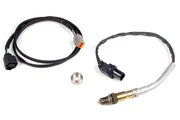
Once the model is in place, a wideband O2 controller tells you the air-fuel ratio the engine actually burned. Compare it with your target. If they don't match, something in the model is off.
- Rule out setup errors first. Wrong displacement, wrong injector flow, missing dead time data, or a MAP or IAT sensor with the wrong calibration will all show up as "bad VE" across the whole map.
- Then adjust VE cells. If the setup is correct, the difference is simply that the numbers in the VE table don't yet match your engine. Tuning the fuel map is the process of nudging each cell until measured AFR lands on target.
- Keep the target table honest. Don't richen the target to cover a VE error. Fix the VE, and leave the target as the mixture you actually want.
Traditionally that cell-by-cell work is done on a load-bearing dyno, which lets you hold each RPM and load point steady. Our dyno tuning basics and base map basics articles cover the practical side, and fuel trims can help fine-tune once the map is close.
Common symptoms and what they usually mean
| Symptom | Usually |
|---|---|
| Whole map rich or lean by a similar amount | Injector flow, displacement or fuel density entered incorrectly |
| Error worse at low load and idle | Missing or wrong injector dead time |
| AFR drifts as the intake heats up | IAT sensor placement or calibration |
| Map looks fine in vacuum but wrong in boost | MAP sensor calibration, or turbo backpressure changing VE, which is normal and just needs tuning |
VE tuning FAQ
Can VE be over 100%?
Yes. Well-designed intake and exhaust tuning can pack a cylinder beyond its static displacement at certain RPM, so peak-torque areas on strong naturally aspirated engines can read above 100%.
Should my VE numbers go up with boost?
Not just because boost went up. The MAP reading already handles the extra pressure. Changes in the boost region come from how the turbo and exhaust affect breathing, so let the wideband tell you what the engine needs.
Is a VE map better than a pulse-width map?
For most builds, yes. Because pressure, temperature, injectors and fuel are modeled separately, you can change injectors or fuel and only update those settings, rather than retuning the whole map. If you'd like help with yours, book a free 30-minute consultation.