VE in plain English
Every four-stroke engine has a swept volume. A 350 cubic inch small block displaces 350 cubic inches (about 5.7 liters) every two revolutions. In a perfect world, each cycle would fill that whole space with fresh air from the intake manifold. In the real world it never quite happens. Valves take time to open, ports and runners resist flow, and some exhaust gets left behind. Volumetric efficiency is the score that describes how close the engine gets: how much air it really moves in one cycle, compared with how much its displacement says it could.
A score of 100% means the cylinders filled completely. A mild street engine might sit well below that at low rpm and climb as the intake and exhaust tuning come alive. Cam profile, head porting, runner length and header design all shift where the engine breathes best. That is why no two engines share the same VE map, even with identical displacement.
Why a tuner cares
Fuel follows air. If the ECU knows how much air went into the cylinder, it can calculate how much fuel to add for the air-fuel ratio you asked for. Once an engine is assembled, its hardware is fixed, and the two things that change how well it breathes from moment to moment are engine speed and engine load. So a VE table is built on exactly those two axes, and each cell holds the efficiency at that point.
It is really about air mass
Here is the part that trips people up. Air is a gas, and a gas doesn't have a fixed volume the way a block of aluminum does. A gallon jug of air in Miami holds noticeably more air, by weight, than the same jug on a hot day in Denver. What combustion cares about is the mass of oxygen, and mass depends on pressure and temperature.
So when we say VE, what the math is really doing is comparing the mass of air that made it into the cylinder with the mass that would fill the displacement at the measured conditions. The ECU gets pressure from the MAP sensor and temperature from the intake air temperature sensor, so it can convert between the two continuously.
Does boost raise VE?
Not by itself. Doubling manifold pressure roughly doubles the mass of air in each cylinder, but the engine isn't pumping any better. It is just being fed denser air. The MAP sensor already accounts for that density, so the VE number doesn't need to jump when boost comes in.
What does move VE under boost is the turbocharger itself. A turbo is a second air pump bolted to the first, and its turbine sits in the exhaust path. The compressor and turbine each have their own efficiency curves, so exhaust back pressure and charge conditions change as boost rises. It is normal to see VE shift across the boost range because of the turbo, not because of the boost number. A supercharger is also an air pump, but it isn't a restriction in the exhaust path the way a turbine is, so it doesn't affect engine VE the same way.
The throttle is the other big restriction, and it's the one we add on purpose. Its whole job is to cut engine efficiency down to what the driver asks for.
Picking the load axis: MAP or TPS
| Load axis | Why it works | Where we use it |
|---|---|---|
| Manifold pressure | In vacuum, the only way to lower MAP is to close the throttle, so MAP tracks throttle closely. Above atmospheric, it separates cells by boost, which captures turbo effects. | Most street and boosted cars with a stable idle vacuum |
| Throttle position | The throttle is what actually sets engine load, so it can describe VE directly. | Individual throttle bodies, big cams with unstable vacuum, some race engines |
Either choice is valid alongside rpm. The principles of tuning the map are the same both ways. Things like variable cam timing, methanol charge cooling, wastegate behavior, intake bleeds and nitrous all add their own layers, but they sit on top of a solid base VE map rather than replacing it.
What the ECU needs from you
A VE system only works if the numbers you feed it are true. Before touching a single VE cell, check these:
| Setting | What it does | Our advice |
|---|---|---|
| Engine capacity | Sets the theoretical air the engine could hold | Enter the real displacement, including any stroker or overbore |
| MAP sensor | Measures manifold pressure for the air density calculation | Choose a sensor with range above your boost target and confirm it reads barometric pressure with the key on, engine off |
| Intake air temperature | Measures charge temperature for the same calculation | Mount it where it sees the real charge, not heat soak from the manifold |
| Injector flow rate | Converts required fuel mass into open time | Use published data for your exact injector and fuel pressure |
| Injector dead time | Accounts for the time the injector takes to open and close | Use the manufacturer's voltage-based data, see our dead time guide |
| Fuel density and stoich | Tells the ECU what fuel you are running | Set these to your real fuel, especially with ethanol blends |
How the fuel calculation flows
- The ECU reads manifold pressure and intake air temperature.
- From those and the engine capacity, it works out the air mass a perfectly efficient engine would take in.
- It looks up the VE table at the current rpm and load and scales that air mass down (or up) to what is really going in.
- It reads your target air-fuel ratio table and divides the air mass by that ratio to get the fuel mass needed.
- Using the injector flow and dead time data, it turns that fuel mass into an injector pulse width.
An air-fuel ratio is a mass ratio. A target of 14.7:1 means 14.7 pounds of air for each pound of fuel. That is why the ECU needs to know your fuel's stoichiometric ratio and density: gasoline and E85 want very different amounts of fuel for the same air.
Tuning the VE map
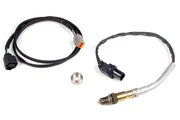
This is where the math meets reality. A wideband O2 controller reads the air-fuel ratio the engine actually burned. Compare that to your target table. When they disagree, something in the calculation is off.
Rule out the easy things first: wrong displacement, wrong injector data, or a MAP or air temp sensor reading incorrectly. Those errors show up everywhere at once. Once they check out, the remaining difference is the VE number itself, and tuning is simply walking through the cells and adjusting each one until the measured AFR lands on the target.
Our workflow
- Start from a sensible base map and get the engine idling cleanly.
- Tune steady-state cells on a load-bearing dyno first. See our dyno tuning basics.
- Keep the target AFR table fixed while you tune VE. Changing both at once hides mistakes.
- Smooth the map. Real engines breathe in curves, not steps.
- Only add closed loop or fuel trims once the base map is right, so they correct small drift and don't mask a bad table.
Troubleshooting a VE map
| Symptom | Usually |
|---|---|
| Rich or lean by the same percentage everywhere | Wrong injector flow rate, wrong engine capacity, or wrong fuel settings |
| Error worse at small pulse widths and idle | Injector dead time data is off |
| AFR drifts as the intake heats up | Air temp sensor placement or calibration |
| VE values look huge or tiny across the whole map | Capacity or injector settings are compensating for each other |
| AFR changes with boost level at the same rpm | Normal turbo effect, tune those cells separately |
VE tuning FAQ
Can VE go over 100%?
Yes, on engines with strong intake and exhaust tuning, cylinder filling can exceed the static displacement in a narrow rpm band. It doesn't mean the math is broken.
Why tune VE instead of raw injector time?
Because the VE map describes the engine, not the injectors. Change injectors, fuel or target AFR and the calculation adapts, so you don't have to retune the whole map.
Should boost be on the load axis?
For a turbo car, yes, the range above atmospheric pressure gives you room to tune the turbo's effect on VE. If you'd like us to look over your map, book a free 30-minute consultation.