Why raise line pressure when it's hot?
Automatic transmission clutches hold by clamping force, and line pressure provides that clamping force. As fluid gets hotter, clutches tend to slip more than normal. Slip turns engine power into heat, which raises fluid temperature further, which causes more slip. Left alone, that loop can cook the fluid and take clutches and other parts with it.
The Temperature Correction table adds line pressure as fluid temperature climbs past the transmission's rated range, so the clutches hold firmly and stop generating heat. This is a protection table, not a comfort table. Shifts will feel firmer when it's pulling in a lot of correction, and that's fine. Don't try to tune those shifts to feel perfect. Tune them so the transmission survives.
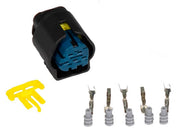
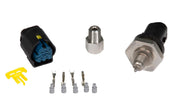
It needs a reliable transmission fluid temperature signal. A sensor like the high-range oil temperature sensor (plug: HT-030315) or the combined Bosch fluid pressure and temperature sensor works well.
How it applies in each mode
What the percentage acts on depends on how line pressure control is set up:
| Mode | The correction changes | Direction for more pressure |
|---|---|---|
| Closed loop or open loop with target | The target pressure, as a percentage of gauge pressure | Positive values |
| Open loop | The duty cycle table output, as a percentage | Usually negative values |
Closed loop: watch gauge vs absolute
The percentage is applied to target in gauge pressure. If you view pressures in absolute units, the numbers can look off. A 10% correction on a 100 psi (690 kPa) gauge target gives 110 psi (758 kPa). In absolute terms that's roughly 114.7 to 124.7 psi, which looks like only about 9%. Nothing's wrong. It's just the atmospheric offset.
Open loop: why the values go negative
On most transmissions, line pressure rises as solenoid duty falls. So to add pressure when it's hot, you take duty away, which means negative corrections. Put positive numbers in by habit and you'll lower line pressure exactly when the transmission needs more. Confirm your transmission's duty-to-pressure relationship in your base duty tables before filling this in.
After setting up the table, log fluid temperature, line pressure and duty on a hot drive. Confirm that line pressure goes up as temperature climbs. That one check catches most sign errors.
Related line pressure tables
Temperature Correction sits on top of your main tables: in-gear target and shifting target in closed loop, or in-gear base duty and shifting base duty in open loop. Wiring is covered in line pressure control wiring. Not sure what your transmission's rated temperature is? Ask us.