What knock control does
When the knock sensors pick up a signal above your knock threshold, the Elite pulls ignition timing to stop the detonation before it damages pistons or ring lands. That quick response is the short term side. The long term side is a learning table: if a particular load and RPM area keeps knocking, the ECU remembers and runs less timing there from then on, even if the base map had too much.
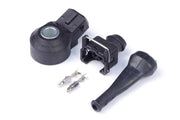
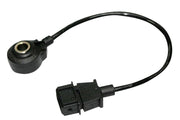
Knock control only works as well as the detection feeding it. Set up knock detection and its thresholds first, with the sensors fitted as described in our knock sensor install guide.
Knock Control tab
Mode
- Unbanked: one knock sensor. Any detected knock is treated as coming from the whole engine.
- Banked: more than one sensor, such as one per bank on a V engine.
Short term settings
| Setting | What it does | Default | Our advice |
|---|---|---|---|
| Short Term Retard | Timing pulled when the knock signal crosses the threshold | 5° | Keep the default until logs show a reason to change it |
| Short Term Decay Rate | How quickly that retard is added back, in degrees per engine cycle | 0.5°/ECyc | Slower if knock comes back as timing returns |
| Hysteresis Time | After a retard, how long before another retard action can stack on top | No default given | Long enough that one knock event isn't counted several times |
Here's how those work in practice. Knock is detected, and 5° comes out instantly. Every engine cycle after that, 0.5° goes back in, so the full 5° is restored after about ten cycles if no more knock appears. Hysteresis stops one burst of knock, which the sensors may pick up across several cycles, from being counted as several separate events and pulling 15° or 20° when 5° was enough.
Long Term Trim tab
Tick Enable Long Term Trim to let the ECU learn. It keeps a table matching your ignition map, and each cell tracks its own correction.
- Long Term Retard: how much timing that cell learns to remove each time knock is detected while running in it.
- Max Long Term Retard: the most the table is allowed to learn in any cell.
Managing what it learned
- Reset clears every learned value back to 0.
- Apply to Base Table writes the learned corrections into your base ignition table.
A learned retard shows where knock happened, not why. Before you apply it to the base table, check that the fuel was right, the knock sensors weren't reacting to mechanical noise, and intake temperature was normal. Applying corrections caused by a bad tank of fuel builds that bad day into your map.
Long term ignition restore
Without restore, learned retard stays until you reset it. Tick Enable Long Term Ignition Restore and the ECU gives timing back to cells that run cleanly.
- Long Term Restore Amount: the advance added back to a cell each time it's sampled with no knock. It keeps adding until it hits Max Restore.
- Restore Sample Rate: how often that check happens, which sets how fast timing comes back.
- Max Restore: the ceiling for restored timing. A positive number here means the table can learn advance above your base ignition table.
That last point deserves care. With a positive Max Restore, the system will creep timing up in cells that never knock. On a well-instrumented race engine that can find some power. On a street car we keep Max Restore at 0, so restore can only give back what knock took away.
Troubleshooting
| Symptom | Usually |
|---|---|
| Timing drops constantly with no audible knock | Threshold too low, or mechanical noise (valvetrain, injectors) reaching the sensor |
| Large retard from a single event | Hysteresis time too short, so the event is counted several times |
| Knock returns as soon as timing recovers | Decay rate too fast, or the base map needs less timing there |
| Long term table fills with retard everywhere | False detection, bad fuel, or a real tune problem. Investigate before applying |
Parts and further reading
For sensors, we use the genuine Bosch knock sensor, and on the dyno the Pro Tuner Knock Ears kit lets you hear what the sensors are picking up. If you're new to the topic, start with what knock is and why you should control it.
FAQ
Is knock control a substitute for a safe tune?
No. It's a safety net for bad fuel, hot days and unusual conditions. The base map should be free of knock on its own.
Should I enable long term trim?
On a street car with a solid tune, yes, with conservative limits. Check the table after a few weeks of driving. It will show you where the engine is on the edge.