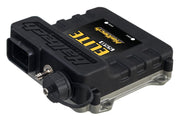
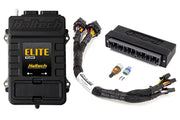
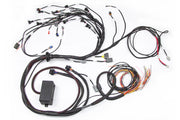
Rather than running injectors, coils, pumps and sensors straight off the ignition switch, a Haltech install powers them through one or more relays controlled by the ECU. That's the engine control relay, or ECR. When the ECR turns on, the engine management components get power. When it turns off, they shut down.
On the Elite 2500, one output is reserved for this job: DPO 6 (Black/Red wire), on pin A25. It works by grounding the relay coils, and it can sink up to 1A in total. That's enough for about five 80-ohm relay coils wired in parallel. Check your relays' coil resistance if you're adding more, because lower-resistance coils draw more current.
How it switches
The ECU has to see switched 12V from the ignition on pin A13. Without that signal the function can't work. When the key turns on, the ECU sees 12V on A13 and pulls the ECR output low, so the relays close and the system powers up.
The useful part comes at key-off. The ECU can keep the ECR engaged for a while after the ignition signal disappears, instead of dropping it straight away. That's what makes a turbo timer possible, letting the engine idle down after a hard drive without leaving the key in. The hold-on behavior is configured when you enable the function.
Use a good-quality relay like the 30A 5-pin power relay. Fuse each circuit it feeds separately, so one shorted injector can't take the whole engine down.
See also Fuel Injectors.