From carburetors to fuel injection
For most of the automotive era, the carburetor did the job of mixing fuel and air, and it did it well enough to win races for decades. Factory electronic fuel injection (EFI) took over through the 1980s and was the standard way to feed an engine by the mid-1990s. Carbs never went away, though. In the muscle car and hot rod world they're still the default, partly for looks and partly because they're familiar.
We talk to a lot of builders who can tune a carb in their sleep and are wary of a laptop. That's fair. The good news is that the concepts carry straight over. You're still deciding how much fuel the engine gets at each speed and load. You just get far finer control and a lot more information to work with.
The parts of an EFI system
- Fuel pump: pushes fuel from the tank to a fuel rail at a steady pressure, instead of relying on a float bowl.
- Injectors: electrically operated valves in the intake manifold, one per cylinder in most performance setups, that spray fuel when told to.
- Sensors: report what the engine is doing, such as RPM, manifold pressure, throttle position and air and coolant temperature.
- ECU: the engine control unit reads every sensor many times a second and decides how long to open each injector.
What the ECU is actually doing
A carburetor meters fuel by physics: air speed through the venturi pulls fuel through jets that you've sized by hand. An ECU works it out instead. It looks at engine speed and load, checks how dense the air is from its temperature and pressure, factors in whether the engine is cold, and calculates the fuel needed for that exact moment. Then it opens the injectors for precisely that long. If you want the deeper version, our article on how ECUs work goes through it step by step.
How tuning changes
Instead of swapping jets, power valves and springs, you tune from a laptop running the ECU's software. The main tool is a fuel map, a table with engine speed on one axis and load on the other. Each cell tells the ECU how much fuel to deliver at that point. That means you can correct a lean spot at 3,000 rpm and light throttle without affecting anything else, which is something a carb simply can't do.
| Carburetor | EFI | |
|---|---|---|
| How you tune | Jets, rods, springs, screws | Tables in software |
| Resolution | A few circuits cover the whole rev range | Every speed and load point can be adjusted |
| Cold starts | Choke, pumping the pedal, flooding | Automatic enrichment from the coolant sensor |
| Weather and altitude | Retune or live with it | Corrected automatically from sensor data |
| Seeing what happened | Plug readings and seat of the pants | Data logs of every sensor |
What you gain
Because the ECU is correcting fueling constantly, most of the classic carb annoyances simply disappear: floats sticking after the car sits all winter, flooding on a cold morning, fouled plugs, a lumpy idle, vapor lock on a hot day. The wiring is also simpler and safer than a pile of separate aftermarket boxes, because one controller is running the show.
For racers, the list gets longer. A modern Haltech ECU can handle data logging and display, multi-stage dry nitrous control, boost control, traction control, knock control, launch control and anti-lag, plus engine protection that can shut things down before a failure becomes expensive. Some of the fastest carbureted drag cars have switched to EFI for exactly these reasons.
What a conversion involves
Every build is different, but a typical carb-to-EFI swap looks like this:
- Replace the carburetor with a throttle body.
- Fit injectors to the intake manifold, either in an EFI manifold or a converted one.
- Upgrade the fuel system: an EFI-rated pump, a rail and a regulator, plus a return line if you're running one.
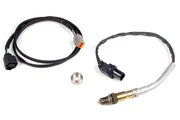
- Install the sensors. A common set is an oxygen sensor, manifold pressure, air temperature, coolant temperature and throttle position.
- Wire everything to the ECU, load a base map, and tune.
Plan the fuel system as carefully as the ECU. A carb pump won't support EFI pressure, and a marginal pump is one of the most common reasons we see for lean conditions on a new conversion.
EFI FAQ
Will EFI make more power than my carburetor?
Not automatically. Peak power comes from the engine's airflow. What EFI gives you is better fueling everywhere else: stronger part-throttle response, easier starts and consistency day to day, and the tools to add boost or nitrous safely.
Do I need to be a computer expert to tune EFI?
No. If you understand what your engine wants from a carb, you already understand the goal. The software is just a more precise way of getting there, and a good base map means the engine will usually start and idle before you change a thing.
Thinking about converting a classic? Read EFI your classic, browse the Haltech Nexus range, or book a free 30-minute consultation and we'll help you plan it.