Why a separate boost pressure sensor?
On most turbo cars the MAP sensor already tells you boost, and it's what the fuel and ignition tables are built on. A separate boost pressure sensor earns its place when you want to measure pressure somewhere else in the system. Common examples we see:
- Pressure before the throttle body, so you can compare it with manifold pressure and see what the throttle and intercooler piping are costing you.
- Pressure in the charge pipe or at the compressor outlet, to spot leaks or a restrictive intercooler.
- A dedicated boost reading for dash display and logging that stays independent of the load sensor.
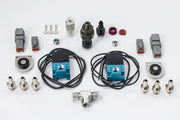
If you're running a CO2 or dual-port wastegate strategy, the CO2 boost control dual solenoid and pressure sensor kit includes its own pressure sensor, so check which input it's wired to before you add another. For the control side, see our Elite boost control guide.
Wiring tab
Choose the input the sensor is wired to. An AVI (analog voltage input) is the recommended option. An SPI (synchronized pulsed input) will also read it if you've used up your AVIs.
| Setting | AVI | SPI |
|---|---|---|
| Pull up available | 1k Ohm to 5V | Weak 10k Ohm to 5V |
| Sensor Type | Not applicable | Hall Effect, which is the setting for any analog signal on an SPI |
Pull up: on or off?
Pressure sensors are almost always three-wire parts with their own 5V supply, ground and signal, so the pull up is normally off. The pull up exists for two-wire sensors, such as thermistors, that can't produce a voltage without one. Also leave it off when the sensor is shared with another ECU, for example in a piggyback install, since that ECU provides whatever the circuit needs.
Calibration tab
ESP includes a set of ready-made pressure sensor calibrations. The yellow Open icon at the top left loads one, and the blue disk icon next to it saves your current calibration to a file. If your sensor isn't listed, create a custom calibration from the manufacturer's voltage vs pressure data. Haltech sensors such as the 5 bar TI MAP sensor or the 150 psi TI pressure sensor are straightforward because their data is published.
With the engine off, the boost pressure reading should match your MAP and barometric readings closely. If it doesn't, the calibration or the absolute vs gauge pressure type is probably wrong.
Display tab
These settings only change how ESP gauges show the channel. They don't affect the sensor reading or anything the ECU does with it.
| Setting | What it does | Our advice |
|---|---|---|
| Warning Maximum | Gauges flash red above this pressure | Set it a little above your highest intended boost so an overboost is obvious on screen |
| Display Minimum | Lowest value the gauge shows | Around full vacuum, so you can see decel and idle |
| Display Maximum | Highest value the gauge shows | Just above the warning, so the needle doesn't sit pinned |
Diagnostics tab
Two voltage checks catch wiring faults. Both are disabled by default. If Engine Protection is active, you can also attach a DTC severity to each.
- Raw Min (P0237): sets when the voltage falls below your limit. A signal shorted to ground or a lost 5V supply will do this.
- Raw Max (P0238): sets when the voltage rises above your limit, typically from a short to 5V or a broken ground.
Set the limits just outside the range the sensor produces in normal use. Most pressure sensors never sit right at 0V or 5V when healthy, which is what makes these checks reliable.
Troubleshooting
| Symptom | Usually |
|---|---|
| Reading pinned at the top or bottom | Missing 5V supply or ground, or the signal wire on the wrong input |
| Reads high by a fixed amount | Pull up left on, or wrong calibration |
| Boost pressure well above MAP under load | Normal to a degree (throttle and piping losses); a big gap points to a restriction |
| Noisy reading | Sensor ground shared with high-current items, or a pulsing vacuum line |
FAQ
Can this sensor replace my MAP sensor?
In a normal setup, no. The MAP sensor remains the load input for fuel and ignition. Think of this function as a second pressure reading you add alongside it.
Does the display range limit what the ECU can read?
No. The display settings only affect the ESP gauges. The sensor's range is set by the sensor and its calibration.