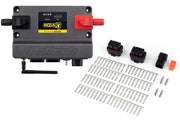
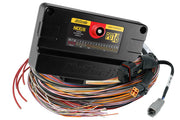
Why let the ECU control the A/C?
An A/C compressor is a real load on the engine. At idle it can drag RPM down or even stall a lumpy cam, and at wide open throttle it's stealing power you'd rather send to the tires. With the Nexus Air Conditioner function, the A/C request switch goes to the ECU instead of straight to the compressor clutch. The ECU then decides when the clutch is actually allowed to engage, and it can raise idle ahead of time so the extra load doesn't cause a dip.
You need two things wired: an input from the A/C request switch and an output that drives the compressor clutch, normally through a relay. Both are assigned on the function's wiring tab. See air conditioner wiring for the details.
When the compressor is allowed to run
Think of the settings as a list of conditions. The driver asks for A/C, and the ECU only engages the clutch if none of these lockouts are active:
| Setting | What it does | Our advice |
|---|---|---|
| Min Engine Running Time | Keeps the compressor off for this long after the engine starts. 0 lets it on straight away. Default 5 s | Long enough for idle to settle after a cold start |
| Maximum RPM | Drops the compressor above this engine speed. Default 4500 rpm | Keep it inside what the compressor is rated for. High-revving engines matter most here |
| Maximum TPS | Drops the compressor above this throttle opening | Set it where the driver clearly wants power, so cruise stays cool but a hard pull gets everything |
| Conditions Time Delay | The shortest time allowed between the clutch switching on and off. Default 5 s | Stops the clutch chattering when the driver is on and off the throttle |
The time delay is easy to overlook, but it's what keeps the system civilized. Without it, a driver hovering around the TPS limit would have the clutch clicking in and out every second, which is hard on the clutch and annoying to drive.
Protecting the A/C system with sensors
If you've set up an A/C temperature sensor or an A/C pressure sensor, extra lockouts appear:
- Air Con Min Temp turns the compressor off when the A/C temperature reading falls below this value, which helps prevent the evaporator from icing up. Air Con Min Temp Hyst is how far the reading has to climb back above that limit before the compressor is allowed on again.
- Min Pressure Enable switches on the low pressure lockout. Air Con Min Pressure stops the compressor if system pressure is too low, a classic sign of a low refrigerant charge that could otherwise damage the compressor. Air Con Min Pressure Hyst is the rise above the limit needed to re-engage.
- Air Con Max Pressure Hyst works with the Max Pressure limit: after a high pressure cut, pressure has to fall by this amount before the compressor comes back.
Every hysteresis setting does the same job. A single on/off threshold makes the output flicker when the reading sits right on the line. Adding a gap between the "off" point and the "back on" point stops that oscillation.
Keeping idle steady
This is where ECU control really pays off. The function works hand in hand with idle control:
- Air Con Idle RPM Offset raises the idle target while the A/C is on.
- Air Con Idle Base Offset raises the idle base duty, so the idle valve or throttle opens up before the load arrives instead of waiting for RPM to drop.
- Idle Time On Delay holds the compressor off for a moment after the request, giving idle control time to lift the target and base duty first. Around half a second is typical.
- Idle Time Off Delay works in reverse when the A/C switches off. The idle offsets come out first, and the compressor stays engaged for this long before releasing, so idle eases back down instead of flaring.
Worked example
Say the car idles at 800 rpm and the compressor pulls it down to 700 when it kicks in. We'd add an RPM offset so the target rises a little with the air on, then add base offset until the ECU is already delivering most of the extra air when the clutch engages. With an on delay of about 0.5 s, the sequence is: driver presses A/C, idle comes up, then the clutch engages into an engine that's ready for it. Log RPM and idle duty and adjust the base offset until the dip disappears.
Pulsed output
Some systems want the compressor output cycled on a fixed rhythm rather than held on. Pulse Enable turns that on. Pulse On Time (default 3000 ms) sets how long the output is active each cycle and Pulse Off Time (default 1000 ms) sets how long it rests. Leave Pulse Enable off unless your compressor setup specifically needs it.
Troubleshooting
| Symptom | Usually |
|---|---|
| Idle dips or stalls when A/C engages | Base offset too small or on delay too short |
| Idle flares when A/C switches off | Off delay too short, so the load disappears before the offsets are removed |
| Clutch clicks in and out on the highway | Driving around the Maximum TPS limit; raise the time delay or TPS limit |
| A/C never engages | Engine running time not reached, a pressure or temperature lockout active, or the input or output not assigned |
FAQ
Do I need A/C pressure or temperature sensors?
No. The basic function works with just the request switch and clutch output. The sensors add protection for the A/C system itself.
Will the A/C cut out when I floor it?
Yes, if you set Maximum TPS. That's the point: the compressor load comes off when you want power and returns once you back off, subject to the time delay.
More Nexus features live under vehicle functions. If you're on an Elite ECU, see air conditioner control in ESP.