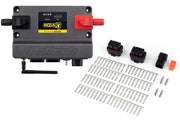
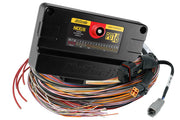
What the Stage node covers
NSP gives every stage of injection its own node. Inside, you set two things: how the ECU drives the injectors on that stage electrically, and when that stage passes fuel delivery on to the next one. Single-stage engines still use the node for the first part. The staging behavior only comes into play once you add a second set of injectors.
Injector current control (Setup)
Injectors differ in how much current they need to open quickly and how little they need to stay open. Setup tells the Nexus how to drive the outputs on this stage. Get it wrong and fueling won't be accurate, and a low impedance injector driven the wrong way can overheat.
| Setup option | How it drives the injector | Use it for |
|---|---|---|
| High | Saturated drive, no current limiting | High impedance injectors. This is the one most engines use |
| 1 - 3 Ohm | Current controlled, 4000 mA peak and 1000 mA hold | Very low impedance injectors |
| 3 - 8 Ohm | Current controlled, 2000 mA peak and 500 mA hold | Low impedance injectors in this range |
| Custom | Your own peak current, peak hold time and hold current | More than one injector per output, or injectors with manufacturer drive data |
Check the injector supplier's data for the impedance. If you run two or more injectors on a single output, always choose Custom, because the current needed changes with the number of injectors sharing it.
The custom settings
- Peak Current: the higher current used to snap the injector open.
- Peak Hold Time: how long peak current is held once the output reaches it. If the injection event is shorter than this time, the event just ends early.
- Hold Current: the lower current used for the rest of the event to keep the injector open without overheating it.
Only use Custom when you have real numbers from the injector maker. Guessing here can hurt injector response or the injectors themselves.
How Nexus staging hands off fuel
Each stage has a Staging Duty Cycle. The logic works like this:
- Stage 1 supplies all the fuel until its duty cycle reaches its staging duty cycle.
- At that point stage 1 holds its duty, and stage 2 starts adding fuel.
- If stage 2 reaches its own staging duty cycle, it holds too, and stage 3 (if fitted) joins in.
- Once every stage is at its staging duty, they all climb toward 100% together. The ECU controls their rates so every stage arrives at 100% at the same moment.
That last step means no single bank is ever flat out while another still has headroom, which keeps delivery even at maximum demand.
Worked examples
| Stages | Staging duty cycles | What happens |
|---|---|---|
| 2 | Stage 1: 50%, Stage 2: 50% | Primaries go to 50%, then hold while secondaries rise to 50%. Past that, both rise together to 100% |
| 2 | Stage 1: 50%, Stage 2: 75% | Primaries hold at 50% while the secondaries climb further, to 75%. Then both climb to 100%, with the primaries rising faster to arrive at the same time |
| 3 | All at 50% | Each stage in turn fills to 50%, then all three rise together |
| 3 | 40%, 60%, 80% | Stage 1 holds at 40%, stage 2 fills to 60%, stage 3 fills to 80%, then all three finish together at 100% |
Choosing staging duty cycles
There's no single right number. Things we weigh on each build:
- Idle and low load quality usually comes from the primaries, often the smaller or better-placed injectors, so let them carry the engine through normal driving.
- The transition is where problems show. When a new stage starts, it has to deliver very short pulses, so accurate dead time and short pulse width data for that injector are essential.
- Log lambda through the handoff and look for a lean or rich blip where the second stage joins.
Each stage's flow, flow percentage and firing angle are set in their own related nodes.
Troubleshooting
| Symptom | Usually |
|---|---|
| Lambda blip when the next stage starts | Dead time or short pulse data wrong for that stage's injectors |
| Injectors run hot or fail early | Low impedance injectors set to High, or wrong Custom values |
| Poor response on shared outputs | More than one injector per output without Custom current settings |
FAQ
What setting do most injectors use?
High. Most modern injectors are high impedance and run saturated.
Do I need staging on a single set of injectors?
No. Staging only matters when you have more than one stage. Planning a staged setup? Book a free consultation and we'll help size it.