An American muscle car in a time attack paddock
Brian Bugh is a Corvette guy who also happens to love time attack, so building a C5 Z06 for the sport was the obvious answer. He runs in the World Time Attack Challenge Open Class, whose rules give a lot of freedom with aerodynamics. You can see it on the car: a very large rear wing, a rear diffuser and a wide front splitter, the kind of package that makes a time attack car recognizable from across the pits.
The engine: simple on purpose
Under the hood is an LS6 V8. Apart from a custom camshaft, the internals are close to stock, and it puts down roughly 440 hp at the wheels. Air comes in through an over-the-radiator intake into a 102 mm billet throttle body.
We like this approach. A healthy, mildly built LS makes reliable power with a broad torque curve, which is exactly what you want exiting a slow corner. It also leaves the budget for aero, tires and brakes, which is where time attack lap time usually lives.
The Haltech side
| System | What's fitted | Why it matters on track |
|---|---|---|
| ECU | Haltech Elite 2500 | Full sequential control of all eight cylinders, plus the engine and chassis functions below |
| Wiring | Haltech terminated LS harness | Plugs straight onto the engine, with fewer joins to fail under vibration |
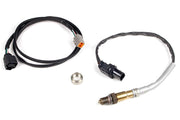
| Lambda | Haltech dual wideband controller kit (the current equivalent is the WB2) | Watches each bank separately, so a problem on one side shows up straight away |
| Dash | Haltech IQ3 logger dash | Driver information and onboard logging in one unit |
| Power control | SmartWire module with a dash switch panel | Electronic control of the car's power circuits instead of a traditional fuse and relay board |
The cockpit is stripped back and functional, with the IQ3 dash at its center. The SmartWire module runs the car's power circuits, and a switch panel on the dash gives Brian direct control of the starter, ignition, Accusump pump, lights, a cool-down mode that runs the thermo fan and water pump, a fuel override, the wipers and the fuel door release.
The Elite 2500 does more than fuel and spark. It also runs the car's traction control, which on a high-grip, high-downforce car helps put a V8's torque down cleanly on corner exit. Our traction control article explains how the Elite handles it.
What we take from it
Brian's car is a good reminder that you don't need an exotic engine to be competitive. A sorted chassis, serious aero, a reliable LS and an ECU that ties the whole car together will get you a long way. If you're planning something similar, our guide to wiring an LS with a terminated harness is a good starting point, and dissecting WTAC's Open Class winner shows how the other end of the grid does it.
Building a track car on Haltech? Book a free consultation and we'll help you spec it.